Showing posts with label 4-star. Show all posts

Review: Oxygen Not Included (Steam)

This is the best game I've ever hated. This adorable and highly addictive game is for people who feel that nuclear physics aren't challenging enough. Even on easy/casual mode (and thank god there's an easy mode), this is the most challenging resource management game I've ever played--and not for the wrong reasons, as is so often the case with these sorts of games. The artificial intelligence for your sims is surprisingly well-implemented, the ability to prioritize tasking on the fly is flawless, and you don't have to micromanage your sims just to get them to eat and sleep as needed. The "every three days" respawn point that awards you a new person or "care package" of needed stuff is highly addictive and pings my ADHD brain juuuust right.

That said, holy cow this game is HARD. You need oxygen? You'll install an algae terranium to turn carbon dioxide (which your sims keep selfishly exhaling) into oxygen. But they produce polluted water, which means you need to invent electric wiring, manual hamster-wheel generators, and a water sieve to turn that polluted water back into clean drinkable water. Which you need because your crops (and algae) keep drinking all your water. But those generators are heating the colony air over time (so much running, so much exercise!) which raises the ambient temperature in your gardens, which means your plants won't grow. Time to either starve to death or invent a complex system of hydrogen-based cooling and air ducts to cool the place down. Whoops, you're out of clean water because your crops were thirsty while you were inventing all that!

Seriously, this is the most realistic space-building sim I've ever played. It's adorable and addictive and I am *very bad* at it. I hate it so much, lol, but I highly recommend it for people who are, well, smarter than I am. I'm going back to lurk in the dark ages with my medieval sims who never ask me to invent anything higher than the Iron Age.

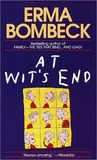
Review: At Wit's End

At Wit's EndAt Wit's End by Erma Bombeck

My rating: 4 of 5 stars

At Wit's End / 0449211843

As a child, I picked up several of Erma Bombeck's books at a used bookstore and read them again and again. Picking up At Wit's End was like returning to the home of an old friend where everything is comforting and familiar, and you can laugh at old jokes together. I was delighted to see that this kindle edition retains the artwork from the paper version, all of which I remembered with fondness.

Most of the essays here are still very very funny. There are times when Erma dips more deeply into sentiment for me than I want from my humor books--the deep sorrow she feels as time passes and her children age hits too close to home and I read those parts very quickly to get through them--but obviously this comes down to personal taste. There's an undercurrent here that I didn't remember from childhood of, hmm, holding men to lower standards than I'm comfortable in my current feminist life, which just shows how far we've come (yay) but made me profoundly sorry to Erma for some of the stuff she felt she had to put up with (boo). If buying this for a young person, expect to have to explain a LOT about the outdated language, the setting, and the culture it was coming from.

I'm happy to have this in my collection, but it's hard to say if I'd ever read it again. Maybe I might just pull it out from time to time to give my 'old friend' a hug.

~ Ana Mardoll

Review: Cheese and Beer

Cheese  BeerCheese Beer
by Janet Fletcher

My rating: 4 of 5 stars

Cheese and Beer / 1449421849

Be aware right this is a *pairing* book. It's not about cheese and about beer, it's about cheese-and-beer together. That wasn't quite what I was looking for, but that's okay! Pairing books are important too.

This is a gorgeous book with a lot of beautiful pictures and a huge variety of pairing suggestions. I've seen another reviews complain that the selections are too easy to find, but I think that's going to vary widely--I'm in Texas, not California, and even the nicest grocers around here don't serve half the cheeses in this book. Fortunately the pairing suggestions are very versatile so you're not going to be "trapped" into being unable to use half the book. The instructions for storing and serving cheese are especially good to know; I'm kind of a foodie when it comes to cheese and I still learned stuff which is always awesome.

NOTE: This review is based on a free Advance Review Copy of this book provided through NetGalley.

~ Ana Mardoll

Review: QUESO!

QUESO!: Regional Recipes for the World's Favorite Chile-Cheese DipQUESO!: Regional Recipes for the World's Favorite Chile-Cheese Dip
by Lisa Fain

My rating: 4 of 5 stars

QUESO! / B01MT4WC2K

I feel like I should like this book more than I do, and I've been sitting on this review for awhile but I need to post it and get it out of my system: this is a good book, but it's not quite the book I wanted.

I thought I was picking up a cookbook... and I was... kinda. There are a lot of chile con queso recipes here, there's no doubt about that. There's only pictures of about half the recipes, which is never a bonus in my book because I want pictures of *all* the recipes. On the one hand, these are queso recipes so the pictures aren't going to vary a whole lot from each other until we hit the more complicated fare. On the other hand, there *is* more complicated fare deeper in--queso with pork and corn and mushrooms, and vegan queso--and yes, I want pictures of those. The pictures which are on the page aren't labeled (or weren't in the Advance Review Copy I received) which means that every 3-4 recipes there's 1-2 pictures and you have to try to match the pictures to the recipes. For a book that I want to browse through when I have a hankering to throw cheese in a pan, that feels like more work than I'd wanted.

This is also a touch of a history book... sorta. The author grew up in Texas (as did I) and was raised on the Velveeta-and-Rotel recipe that white Americans grew up on in the American South back in the day. Then she started branching out and researching the roots of the recipe and visiting different Texas towns to gather regional samples. She's looked into fondues and rarebits and other melted cheese dishes. All of this research has gone into little 2-3 page "histories" before each section of queso recipes, along with little paragraphs of historical context with each recipe.

I love food history so I feel like I should like these parts more than I do. There's a distressing shallowness to a lot of the history, like there's a deeper story and we're just getting a couple condensed sentences that would go on a Wikipedia stub until someone fleshed the material out properly. And the history we do get feels very much like a white outsider peering in--and sometimes in the wrong directions. From the very beginning, the author explains that her trek-for-queso took her from El Paso to Corpus Christi to Austin to Houston to San Antonio. I would've expected at least one jaunt over to Mexico while she "drove along the Texas-Mexico border". The first section of queso recipes features recipes from Los Angeles, Boston, San Antonio, El Paso, Arkansas ("Arkansas Cheese Dip"), Lubbock (a Velveeta-based recipe), and Lady Bird Johnson's Washington Post recipe.

Those feel like very unusual choices to set the stage for a book that is trying to be a history of queso. I feel almost like I'm reading a gentrification of queso--the Arkansas Cheese Dip is called "the term preferred by folks in Arkansas". Do you mean white folks in Arkansas? Because you can say "white folks". I'm assuming Spanish-speaking Arkansans still just called it chili con queso. (Though they probably didn't make it with "1 pound yellow American cheese" and ketchup, so maybe "Arkansas Cheese Dip" is the better term after all.)

I dunno, I feel like I'm being mean. As a coffee table book for Christmas, I think this is perfectly adequate. As an addition to your cookbooks to flip through when you want cheese to nosh on, I think it works. If you're interested in the history of chili con queso in America as adopted as part of the American culture, I think this is an interesting read. If you go into the book with that mindset, I think you won't be disappointed.

NOTE: This review is based on a free Advance Review Copy of this book provided through NetGalley.

~ Ana Mardoll

Review: The Freddy Files

Five Nights at Freddy's: The Freddy Files: The Official Guidebook to the Bestselling Video Game SeriesFive Nights at Freddy's: The Freddy Files
by Scott Cawthon

My rating: 4 of 5 stars

The Freddy Files (Five Nights at Freddy's) / B06X9C7K2L

I am the biggest FNAF fan. I'm not good enough at the game to play past the first couple of nights, but I've seen a million youtube videos and am a particular fan of Markiplier's vids. I've surfed the FNAF wiki for countless hours of my life and read all the fan theories and lurked on forums while they were argued and hashed out. I own both the novels, and I think they're incredible and recommend them whenever I get the chance. I'm that level of invested, so of course I was going to buy this guidebook.

I'm glad I did! The guidebook is *beautiful* with glossy pictures on my screen (I bought the kindle version) and high quality images. A lot of work went into making this book both accessible for newbies who would have no idea what is going on but still interesting to fans who know all the basics. There's additionally a lot of interesting material regarding the actual gameplay: the sections for each game include maps of the facilities, little dotted-line tracks that show the paths of the animatronics, and player hints and tips. Even for a non-player like me, the tips were interesting to read, which is a hard balance to maintain! That was well done and I'm impressed.

So where's the downside? Well, this book is short. 160 pages and you can tear through it in about an hour. Not all the secret screens are shown, which doesn't make a lot of sense to me because (a) the writers clearly had access to the screens and (b) that's kinda what a lot of us are here for. References are made to "opening up the game files" for ourselves to look, but that's what I bought a book for! Don't get me wrong, there are some secret pictures here--good ones!--but there are quite a few missing. Similarly, if you couldn't get into the novels don't expect a plot summary here; the material covering the novels is more like spoiler-free "teaser" material to pique your interest. On the one hand, I'm okay with this because I *like* the novels, but on the opposing hand I'm not sure why you would include them in a guidebook if there's no actual guiding through the material.

The other thing that I'm not sure how I feel about is the "fan theories" in the guide. The guide has done a great job assembling and summarizing quite a few of the major fan theories and that's awesome! But Scott Cawthon--the game designer and writer!--is listed as an author to this guide as a selling point, i.e., this is the "Official" guide and not yet another fan creation. In which case, I was coming into this hoping for... something more than I could find on the FNAF fan wiki? some official "Word of God" material from the actual creator? I didn't expect Scott to answer all the questions surrounding the series, but a few new tidbits of information would have been nice.

[side note] This book covers material from FNAF 1, 2, 3, 4, 5 (Sister Location), and the two novels (Silver Eyes and Twisted Ones). There is no mention of the RPG spin-off (FNAF World), which is something of a shame because while I'm dimly aware that it was a disastrous train-wreck of a game, I would have enjoyed seeing its inclusion in this guide, its secrets (if it had any!), and some discussion of what went wrong. I understand not wanting to include one's failures in a guidebook that is trying to be accessible to bring in new fans, but I would have liked to see it here regardless. [end side note]

As it is, I don't think there's anything here in this guidebook that you can't get for free online. And that's okay! I think it's useful to have the "bare essentials" of the story and fan theories all bound up in a single beautiful edition. Collectors should buy the book and fans will love the stroll down memory lane. It's a good book and I have no regrets, and I'll almost certainly refer to it in the future if another game in the series comes out. But I'm a teeny tiny bit disappointed by the absence of any new material--in a perfect world, I would've liked some teasers released in this, or at least an announcement of a new installment in the series!

~ Ana Mardoll

Review: Resume Templates by ItsPrintable

Should you find yourself in need of a new resume, these templates by Its Printable on Etsy are truly lovely. You do have to install your own fonts (which are provided in the purchase), which means you really do need to print the resume--either on paper or in a PDF format--because you can't send the Word document unless you know the recipient will have the fonts on their end, but yeah. Lovely.

Review: The Silence of the Lambs

The Silence of the Lambs  (Hannibal Lecter, #2)The Silence of the Lambs
by Thomas Harris

My rating: 4 of 5 stars

The Silence of the Lambs / 0099446782

On the grounds that everyone else on earth has seen the movie, I rented Silence of the Lambs over the weekend and found it surprisingly better than I'd expected: as far as classic films go, the movie held up well, and I was pleased to find how much of the movie explores institutional misogyny in the FBI and how Clarice Starling is forced to navigate a lot of hurdles that her male colleagues don't. Indeed, the movie piqued my interest enough that I bought the kindle book and audible audiobook and read along with the narrator to see if this theme was explored in more depth in the novel.

Twenty-four hours later, I'm still not sure how to rate this book. I found it entertaining to read/listen to. The novel is well-written from a purely technical perspective, though the occasional jumps to present tense when talking about people from Starling's past were sometimes disconcerting for me, since I'm less used to that style of writing. (Example: "Jimmy Price *is* a supervisor in Latent Prints at the Washington lab. Starling *did* time with him as a Forensic Fellow." [emphasis mine]) In some ways, the novel reminds me of the parts I liked in Steig Larsson's Millennium Trilogy, and the way the author could use otherwise "mundane" details to make the story feel vivid and immediate.

Also like Steig Larsson's trilogy, I feel like this book is trying to be an ally to women, and seeks to make some good feminist points...but I'm not sure how well it succeeds. I like protagonist Clarice Starling and I love her roommate Ardelia Mapp, and their conversations are some of the best in the novel. There's a lot of institutionalized misogyny that Clarice is forced to navigate around, just like in the movie, and quite a bit of this is handled reasonably well. There's a good conversation with Hannibal Lector about how society mistakes rage for lust, which I thought was a good dismantling of a lot of false "rape is a compliment" narratives. And I deeply appreciate the point made later in the novel when Clarice notes the incongruity in a case where all the victims are women, and yet NONE of the investigators are. That is a very crucial point that needs to be hammered home, and Harris does a good job of it.

On the other hand, the level of issues in this novel for female bodies that happen to be fat just about took my breath away, and it can't all be laid at the doorstep of the misogynistic serial killer. I didn't know whether to laugh or cry when Starling came to the conclusion that the serial killer would have been *forced* to stalk his victims (as opposed to kidnapping them opportunistically) because tall, fat women "aren't common" and that if he'd just staked out a location waiting for one to walk by then he "could sit for days and not see one." Because us tall, fat women are like invisible pink unicorns! And our invisibility is an objective fact and not a matter of people only noticing the people they subjectively prefer to focus on.

Additionally, the author can't seem to decide what level of "sisterhood" he wants to push as part of the narrative. It's a very good point that a case with all-women victims deserves to have women investigators on the team. And Starling may well be correct when she claims that she "can walk in a woman's room and know three times as much about her as a man would know", although I would say that statement is an over-generalization that very much depends on both the woman who owns the room and the hypothetical man looking at it.

At the same time, Starling has moments where she has to push through her own rage and distaste and misplaced pity: anger at women who were born into more money than she; distaste for women with fat bodies who are axiomatically "hard on [their] shoes" which are "strained into ovals"; pity on fat women who are willing to date men who aren't turned off by fat bodies. I think Harris intends these details to make Starling realistically flawed, yet even after she works through her issues, she still feels judgmental of other women, trapped in the Exceptional Woman stereotype that helps her navigate institutionalized sexism but doesn't tear it down. The overall effect muddles the intended feminist message I feel the author is trying to deliver.

I've noted elsewhere that the movie is a mess when it comes to trans* issues, and the book tries to do better. There's much firmer establishment here of the fact that the serial killer is not a trans woman and that most trans* people are not violent -- indeed, that violence is much more common among cis people. But there's still the problematic framing that trans* people are "passive", which is a blanket characterization which others trans* people into a monolith with a word which is almost never used in a positive manner. ("Passive" is rarely a compliment, in my experience.) Additionally, the assessment of why the killer is not really trans* largely boils down to "because he gave the wrong answers on the psychiatric assessments", and some of these passages in the novel end up sounding reductionist, like there's only one "right" way to be a trans* person. As with the women's issues, it feels like the narrative was TRYING to be sensitive, but missed the boat.

I want to be clear, because sometimes my reviews are misunderstood: I enjoyed this novel. I'm giving it 4-stars. I'm pleased that I bought and listened to/read it. I might read it again someday. If you don't mind the above issues and/or can turn off the parts of your brain that are bothered by them for however long it takes to read a classic thriller novel, I recommend this book as enjoyable. But at the same time, this isn't a flawless novel of perfection, and I was a little disappointed to see an author try so hard to be an ally and miss the mark in places. Though I'm glad he tried at all, I hope that future writers who are inspired by this classic will improve on these flaws.

A note on the audiobook for this novel: I purchased the unabridged recording narrated by Frank Muller through Audible. Muller does a good job on the narration, but there's a persistent white noise hum in the background that I managed to tune out *except* when there was complete silence between chapters, at which point I noticed the soft white noise hum all over again when it started up in the next chapter -- each new chapter, I had to re-acclimate to the underlying sound, which took several sentences to get used to.

There's also a weird artifact on the track at the moment: at some points in the narration, there's "ghosting" on the track, as though there were two identical recordings of Muller's voice (a left and a right for stereo, maybe?) and one track suddenly falls a half-second behind the other, so it sounds like he's repeating himself for a moment until the voices re-sync. You can hear this at half a dozen points in the audio, including at Chapter 15 at time 3.08.49. I've reported this content error to Audible and they've been able to reproduce the error on their end, but they haven't yet fixed it as of 6/2/2013.

~ Ana Mardoll

Review: The Slither Sisters

The Slither Sisters (Tales from Lovecraft Middle School #2)Tales from Lovecraft Middle School #2: The Slither Sisters
by Charles Gilman

My rating: 4 of 5 stars

Tales from Lovecraft Middle School #2: The Slither Sisters / 1594745935

"Slither Sisters" picks up as the second in this series after "Professor Gargoyle", and I do feel like this installation in the series is even stronger than the first. As a brief recap of the series as a whole: Everyman YA Protagonist Robert Arthur lives in a world much like ours (minus anyone ever having heard of H.P. Lovecraft), except that Cthulhus and Shoggoths are using his middle school as a dimensional vortex for passing between worlds. The series relies heavily on Lovecraftian monsters, but doesn't delve as much into the tone and themes (presumably because this isn't meant to emotionally scar the targeted audience).

"Professor Gargoyle" ended with the revelation that the two missing twins -- Sarah and Sylvia Price -- have "returned" but are really Lovecraftian monsters in human form. "Slither Sisters" picks up from that revelation with the announcement that the girls are running for student body president and, if successful in their campaign, will use their position to kidnap more students for a body exchange. The plot summary sounded a little twee to me, but to its credit the book really manages to make middle school politics something engaging and interesting to get into, possibly because Lovecraftian monsters are summoned left and right to liven things up.

Additionally, there's a lot of new character development around girlfriend Karina and school librarian Ms. Lavinia and I found those side-developments to be genuinely engaging. Everyman Robert Arthur tends to be just-barely-not-bland for me (although younger and/or male readers may feel differently), but fleshing out Karina's existential angst and Ms. Lavinia's unexpectedly horrifying existence went a long way towards guiding this series back to more Lovecraftian themes of isolation and terror, so well done there. Finally, I loved the concluding chapters of this novel. It's very rare for a YA novel to genuinely surprise me these days, and I was taken completely off-guard by the ending and was absolutely delighted.

And I forgot to mention this in my review of "Professor Gargoyle", so I'll mention it here: I own the Kindle version for both these books and am very impressed with the formatting. The pictures are lovely, and the chapter headings are a very nice touch. There's even drop-caps here and there when appropriate, and it's nice to see a publisher treat the Kindle version right. Kudos.

NOTE: This review is also based on a free Advance Review Copy of this book provided through Amazon Vine. (I received the ARC, and then purchased the Kindle version.)

~ Ana Mardoll

Review: Professor Gargoyle

Professor Gargoyle (Tales from Lovecraft Middle School, #1)Tales from Lovecraft Middle School #1: Professor Gargoyle
by Charles Gilman

My rating: 4 of 5 stars

Tales from Lovecraft Middle School #1: Professor Gargoyle / 1594745919

"Tales from Lovecraft Middle School" is a new YA series I've stumbled into; the books are set in a world much like our own, with the minor difference that no one has ever heard of H.P. Lovecraft, and Cthulhu and Shoggoths and whatnot all exist and are rapidly crawling out of the woodwork at the local brand-new middle school. And our everyman YA protagonist Robert Arthur is stuck in the middle between the adults-who-don't-know and the monsters-who-do.

I love Lovecraftian stories and am always down for a new exploration of the mythos, but I will admit upfront that these books are a little disappointing in the execution of the themes. For me, at least, it's not really enough to slap demons and tentacle-monsters into a book for it to be Lovecraftian; if there's not soul-crushing foreboding and a descent into a horrified lonely mind-breaking nightmarish existence, then it's just not the same. And "Tales from Lovecraft Middle School" doesn't really delve into existential angst or soul-striping fear, probably because the targeted YA audience needs to be able to sleep at night. I get that, and I think the series is fine as a "Lovecraftverse, but not Lovecraftian feel", but if you are coming to the series for that, be aware you're probably not going to get it.

Once I got over my initial disappointment that the tone wasn't quite what I'd hoped for going in, I was pleased to find that this book is still solidly good. It reminds me a lot of the Percy Jackson series, but with Lovecraftian monsters instead of Ancient Greek Mythology ones, which I think we can all agree is a positive thing. The writing is solid, the action moves at a good clip, I never felt like the narrative got bogged down in any place, and the characterization is really well-developed. I think I liked the characterization the most, actually; Robert Arthur is an everyman, but avoids coming off as bland, and his girlfriend and sidekick are both surprisingly well realized. I was also pleased to note that while at least one twist is telegraphed reasonably far in advance for the genre-savvy reader, a final twist is justified nicely enough that it felt very natural indeed. So kudos for that.

Overall, this opening to the series is well-written and fast-paced and I enjoyed it thoroughly once I adjusted my expectations for the content. This probably won't curl your toes in fear, but if you like mythological YA school series, this one can scratch a somewhat edgier itch.

~ Ana Mardoll

Review: The Children of Henry VIII

The Children of Henry VIII
by Alison Weir / narrated by Simon Prebble

My rating: 4 of 5 stars

The Children of Henry VIII / B008QYINQU

I gave "The Children of Henry VIII" four stars when I rated the text version, and I'm happy to give this audiobook the same. I still don't care as much for Simon Prebble as for Weir's other narrators; in general I prefer narrators of the same gender as the author for non-fiction, and in specific to this case, I don't care for some of Prebble's pronunciations. I preferred Judith Boyd's ("The Lady in the Tower") smooth "Shap-we" (for Eustace Chapuys) to Prebble's "Chap-poo-we". However, since this is a direct follow-on book to 'The Six Wives of Henry VIII", it's nice to have the same narrator for continuity.

If you're coming to the audiobook without having read the book, this is a solid scholarly look at the four heirs of Henry VIII: Edward, Jane Grey, Mary, and Elizabeth. The book follows the relationships between the heirs and not so much the reigns of the heirs themselves, which means that the book stops rather abruptly at Mary's death and Elizabeth's accession since there are no more inter-heir relationships to document at that point -- though you can continue from there with Weir's "The Life of Elizabeth I", which I do recommend).

~ Ana Mardoll

Review: The Invasion of the Body Snatchers

The Invasion of the Body Snatchers
by Jack Finney / narrated by Kristoffer Tabori

My rating: 4 of 5 stars

Invasion of the Body Snatchers / B002VACTHE

I bought this audiobook on the recommendation of a friend and I'm still uncertain how to rate it, especially as I haven't rated the book text itself elsewhere. I'll try to address both here, the book content and the quality of the audio book.

The audiobook itself is quite good. The narration is strong and does a lot to flesh out the narration voice -- indeed, I think the narrator manages to make an otherwise forgettable or even unlikeable character very sympathetic. The wry humor and deep weariness of the narrative voice comes through loud and clear, and it does a lot towards creating the atmosphere that this book is trying to evoke: when a major plot point is that the weary heroes cannot sleep or all will be lost, it's a plus to have a weary-sounding narrator. And it works very well as a whole.

The book itself I'm less enthused over. I recognize that this is a book from the 1950s and was revolutionary in its own way, but sometimes it doesn't feel like it has aged well. There's some casual misogyny here that may be distracting to the reader, and the heroes don't always face their apocalypse very sensibly. Readers will figure out major plot points long before the characters do, which makes them sometimes seem willfully obtuse. (This is one of the unfortunate side-effects of modern readers being genre-savvy to this form of literature, I suppose.)

Early in the stages of the apocalypse, the reasons given for why the heroes can't go to the authorities for help seem sort of flimsy, culminating at a point where they manage to call someone in Washington in order to register concern only to be talked out of it because, meh, it all seems kind of silly so nevermind. I get that this is supposed to be a commentary on the inefficient authorities against internal threats, but you'd think once you got through the phone lines, you'd at least TRY to register that stuff is about to go very, very badly. 

Overall, if you already know you enjoy this book, I think you'll be pleased with the audiobook version. If you've heard of the book because it was groundbreaking for its time, and if you don't mind some of the usual flaws of 1950s science fiction -- genre-ignorant characters and sometimes very slow pacing -- then you may well enjoy this book. I give it 3 stars for the text and 5 stars for the narration itself.

~ Ana Mardoll

Review: World War Z

World War Z
by Max Brooks / narrated by a full cast

My rating: 4 of 5 stars

World War Z / B002V8DH36

I love Max Brooks' "World War Z", and I heartily recommend the book to anyone who is interested in zombie tales, particularly world-building after the apocalypse. The only complaint I have with this audiobook edition -- and the only thing keeping it from being a full five-stars -- is that it is an abridgement. In order to keep the narrative flow, they kept in the "essential" stories, but I feel that it was the "flavor" stories that brought so much originality and creativity to the text. I understand why they had to go, but I am sorry for it.

The cast of voice actors here are superb, and even if you don't like abridgements (I usually avoid them, myself), I think most people will get tremendous enjoyment out of this one.

~ Ana Mardoll

Review: The Complete Stories of Sherlock Holmes, Volume 3

The Complete Stories of Sherlock Holmes, Volume 3
by Arthur Conan Doyle / narrated by Charlton Griffin

My rating: 4 of 5 stars

The Complete Stories of Sherlock Holmes, Volume 3 / B004LOPYW0

I really enjoy the Sherlock Holmes stories and books, so I was happy to find this available in audiobook form. The narration isn't as great as I'd like -- the narrator speaks a little too quickly for my tastes and some of his voices (particularly for female characters) sound a little distractingly silly -- but overall this is a solid compilation and I'm happy to have it. Note that while it's the "complete" stories, they're spread across three volumes, so you'll have to buy all three to have the total collection. Speaking of, I really wish the Audible application could show which track corresponds to which story (rather than just Chapter 1, Chapter 2, etc. for the whole kit and kaboodle) but that may be a technical limitation they couldn't get around.

Volume 3 consists of the novel "The Valley of Fear", and the stories in "His Last Bow" and "The Case Book of Sherlock Holmes".

"His Last Bow" contains the following stories:
- The Adventure of Wisteria Lodge
- The Adventure of the Red Circle
- The Adventure of the Bruce-Partington Plans
- The Adventure of the Dying Detective
- The Disappearance of Lady Frances Carfax
- The Adventure of the Devil's Foot
- His Last Bow

"The Case Book of Sherlock Holmes" contains the following stories:
- The Adventure of the Illustrious Client
- The Adventure of the Blanched Soldier
- The Adventure of the Mazarin Stone
- The Adventure of the Three Gables
- The Adventure of the Sussex Vampire
- The Adventure of the Three Garridebs
- The Problem of Thor Bridge
- The Adventure of the Creeping Man
- The Adventure of the Lion's Mane
- The Adventure of the Veiled Lodger
- The Adventure of Shoscombe Old Place
- The Adventure of the Retired Colourman

~ Ana Mardoll

Review: The Complete Stories of Sherlock Holmes, Volume 2

The Complete Stories of Sherlock Holmes, Volume 2
by Arthur Conan Doyle / narrated by Charlton Griffin

My rating: 4 of 5 stars

The Complete Stories of Sherlock Holmes, Volume 2 / B003FCIORQ

I really enjoy the Sherlock Holmes stories and books, so I was happy to find this available in audiobook form. The narration isn't as great as I'd like -- the narrator speaks a little too quickly for my tastes and some of his voices (particularly for female characters) sound a little distractingly silly -- but overall this is a solid compilation and I'm happy to have it. Note that while it's the "complete" stories, they're spread across three volumes, so you'll have to buy all three to have the total collection. Speaking of, I really wish the Audible application could show which track corresponds to which story (rather than just Chapter 1, Chapter 2, etc. for the whole kit and kaboodle) but that may be a technical limitation they couldn't get around.

Volume 2 consists of the novel "The Hound of the Baskervilles", and the stories in "Memoirs of Sherlock Holmes" and "The Return of Sherlock Holmes".

"The Memoirs of Sherlock Holmes" contains the following stories:
- The Adventure of the Silver Blaze
- The Adventure of the Cardboard Box
- The Adventure of the Yellow Face
- The Adventure of the Stockbroker's Clerk
- The Adventure of the "Gloria Scott"
- The Adventure of the Musgrave Ritual
- The Adventure of the Reigate Squires
- The Adventure of the Crooked Man
- The Adventure of the Resident Patient
- The Adventure of the Greek Interpreter
- The Adventure of the Naval Treaty
- The Adventure of the Final Problem

"The Return of Sherlock Holmes" contains the following stories:
- The Adventure of the Empty House- The Adventure of the Norwood Builder
- The Adventure of the Dancing Men
- The Adventure of the Solitary Cyclist
- The Adventure of the Priory School
- The Adventure of Black Peter
- The Adventure of Charles Augustus Milverton
- The Adventure of the Six Napoleons
- The Adventure of the Three Students
- The Adventure of the Golden Pince-Nez
- The Adventure of the Missing Three-Quarter
- The Adventure of the Abbey Grange
- The Adventure of the Second Stain

~ Ana Mardoll

Review: The Complete Stories of Sherlock Holmes, Volume 1

The Complete Stories of Sherlock Holmes, Volume 1
by Arthur Conan Doyle / narrated by Charlton Griffin

My rating: 4 of 5 stars

The Complete Stories of Sherlock Holmes, Volume 1 / B002V0RHKS

I really enjoy the Sherlock Holmes stories and books, so I was happy to find this available in audiobook form. The narration isn't as great as I'd like -- the narrator speaks a little too quickly for my tastes and some of his voices (particularly for female characters) sound a little distractingly silly -- but overall this is a solid compilation and I'm happy to have it. Note that while it's the "complete" stories, they're spread across three volumes, so you'll have to buy all three to have the total collection. Speaking of, I really wish the Audible application could show which track corresponds to which story (rather than just Chapter 1, Chapter 2, etc. for the whole kit and kaboodle) but that may be a technical limitation they couldn't get around.

Volume 1 consists of the novels "A Study in Scarlet" (which is very long), and "The Sign of Four", as well as the stories in "The Adventures of Sherlock Holmes". That collection contains the stories "A Scandal in Bohemia", "The Red-Headed League", "A Case of Identity", "The Boscombe Valley Mystery", "The Five Orange Pips", "The Man with the Twisted Lip", "The Adventure of the Blue Carbuncle", "The Adventure of the Speckled Band", "The Adventure of the Engineer's Thumb", "The Adventure of the Noble Bachelor", "The Adventure of the Beryl Coronet", and "The Adventure of the Copper Beeches".

~ Ana Mardoll

Review: The Divine Comedy

The Divine Comedy
by Dante Alighieri / narrated by Ralph Cosham

My rating: 4 of 5 stars

The Divine Comedy / B002V0TLKM

I like being able to follow along to audio books with my eyes, when possible. This Carlyle-Okey-Wicksteed version is a little obscure, but can be borrowed as an ebook at Open Library. Note that the audiobook skips over the opening introduction by Grandgent in the book edition; the sync between audio and book occurs at "Note on Dante's Hell" on page 25 of the PDF version. (Also note that the ePUB version is a very poor OCR with a lot of artifacts; stick with the PDF would be my advice.)

As for the audiobook quality, I really like the narrative and reading - it's very flowing and well-done. Each Canto leads in with a quick summary as to what is about to happen, and I found these very helpful as a listener, but it would have been more helpful if it were easier to tell the difference between the narrator's "summary voice" and "reading voice". The difference between his inflections on these is *very* subtle. (As a side note, this is the same narrator who reads my copy of The Jungle Book, which is all kinds of awesome.)

Overall, I really like this audio book version of The Divine Comedy and feel like the book was worth the price.

~ Ana Mardoll

Review: The Manhattan Madam

The Manhattan Madam: Sex, Drugs, Scandal and Greed Inside America's Most Successful Prostitution RingThe Manhattan Madam
by Kristin Davis

My rating: 4 of 5 stars

The Manhattan Madam / B001RCTA1A

I picked this book up after seeing an article about it what it says about Eliot Spitzer; I thought it might be interesting to read what appeared from the sample to be a sex-positive exploration of the sex industry from the point of view of a high ranking madam.

In that respect, the book doesn't disappoint. There's not a lot of explicit sexual details in this book, as Davis states that she did very little actual sex work herself and instead handled the marketing, phones, and other details of the business. But what she does dive into is fascinating and detailed; the reader gets walked through the ins and outs of marketing sex work, how to handle impatient and powerful men who don't like to wait even a few minutes for their 'date' to get to their home, and all the behind-the-scenes details that went into building Davis' lucrative sex empire from the ground up.

If there's a failing here, it is perhaps how detached Davis sounds from the sex side of the business. She has a lot of negative things to say about most of her workers, and the reader may feel torn between sympathy for Davis (who is being flaked out on by her workers in many anecdotes) and sympathy for the nameless, faceless workers (who are 'flaking out' because in many cases they are struggling with debilitating drug addictions). There's a point in there somewhere where, sex-positivity or not, it all starts to seem very sad. Davis is clear that she walks each of her employees through an orientation and explains that sex work isn't all dates and chaste hugs like in the glamorous portrayals in movies, but it's clear that for at least some of her employees, they held out a painful hope that it could be.

Probably the thing I enjoyed most about this book was the frank exploration of the johns who frequented Davis' business, though of course all of them (except Spitzer) have been given aliases. It's interesting to see how ridiculously demanding many of them were, and how Davis built her business by providing the emotional side while her workers handled the physical side. Davis rents cars for her clients, arranges their schedules for them, texts reminders to them, and takes their calls all hours of the day and night so that she can provide them charming conversation and soothing reassurances while they men wait for their "girls" to arrive. In return, more than a few of these ridiculously rich and powerful men try to coerce the girls to do unsafe or unwanted acts, or try to weasel out of paying the agreed-upon fee. To Davis' credit, she stands up numerous times for her workers, choosing to blacklist sketchy or coercive clients at the first sign of trouble rather than let her workers operate under unsafe or uncomfortable circumstances.

"The Manhattan Madam" is an incredibly quick read, weighing in at 112 pages on my eReader. I enjoyed the book, and the fast and breezy tone made it easy to whip through. Davis is pretty clearly in favor of legalizing sex work, and she makes a compelling case for it through her personal experiences, and it is deeply fascinating to see her side of the business close-up. Having said that, I'm not at all certain this is worth the (current) high price, but I would recommend checking it out at a library, if you can find it.

~ Ana Mardoll

Review: Resident Evil Genesis

Resident Evil: GenesisResident Evil: Genesis
by Keith R.A. DeCandido

My rating: 4 of 5 stars

Resident Evil: Genesis / 9780743492911

I adore the Resident Evil film series, and I'm a sucker for a good film novelization, so unsurprisingly this book was right up my alley. This is a straight-up "book of the film" translation, with everything captured precisely as it was on-screen, but with deeper characterization, back-story, motivation, and internal emotional snap-shots. As I consider that to be basically the gold standard for film novelizations, I can strongly recommend this book to fans of the film.

The only thing that didn't resonate perfectly with me is that this is a film series that really focuses on its female protagonists to a wonderful degree; I can't think of another film series (let alone an action series) that has such a wide cast of women, and from so many backgrounds and dispositions. This installment alone has three major female POV protagonists, as well as a couple quick chapters from minor female POV characters. So it's a bit unsettling at times to read from the POV of all these women and yet have certain things feel a little ... off, I presume because of the male author. DeCandido seems to be a very competent writer based on what we see here in this novel, but there is some clunkyness around the beginning, as though the book has big "This Is The Flirting Section" and "This Is The Sexual Harassment Section" signs all over it.

An example that comes to mind is the chapter in which Alice meets Spence for the first time. Alice is established as stunningly beautiful in a male-dominated career where she's experienced her fair share of sexual harassment and unfair glass ceilings. We understand intuitively from this background that Alice is presumably very used to being hit on by the men in her workplace. So when Spence -- a man who has been assigned to live alone with her in an isolated mansion for three solid months -- immediately makes three pointed suggestions about her body, it's a little strange to see Alice treat what has been established as a normal thing in her life (co-worker getting handsy with his eyes) as something deeply complimentary and worthy of flirty reciprocation with little "oh, YOU" rejoinders and shooting Obviously Fake Glares at him before leaping into bed with him. I would assume this is meant to establish Alice as sex-positive, but it just doesn't seem to fit well against her otherwise very cautious and careful demeanor and background.

Little speed-bumps like the above are littered sparsely across the first half, but once the T-virus hits the fan, it's a race to the finish and everything falls into perfect place, writing-wise. I give this book a solid 4.5 stars and recommend it happily if you can get past the beginning.

~ Ana Mardoll

Review: He's a Stud, She's a Slut

He's a Stud, She's a Slut, and 49 Other Double Standards Every Woman Should Know
by Jessica Valenti

My rating: 4 of 5 stars

He's a Stud, She's a Slut, and 49 Other Double Standards Every Woman Should Know / 9781580052450

I really loved Valenti's "The Purity Myth", and I've been reading Feministing off and on for years, so I was pretty primed to like this book, but now that I've read it I'm not quite sure how to rate it. The material here is good, and each of these double standards are absolutely worth calling out for explanation as to why they are harmful to women (as well as other minorities who may or may not overlap but who nonetheless get hurt by institutionalized misogyny). So from that perspective, this is a wonderful book that calls out genuine problems and gathers them all up for a precise take-down.

On the other hand, though, this is really very "intro" material -- people who have been involved in feminist blogging for an extended length of time may end up being a bit disappointed by the fast-and-furious tone that effectively means that each of the double standards gets a mere four pages dedicated to it. That's probably to be expected in a book that covers as many topics as this, but I was nevertheless a little disappointed.

Little things, too, niggled at me a bit. Valenti does address fat acceptance here, especially in a wonderful piece on why "fat suits" in movies are problematic, but the heading for each chapter (and the cover of the book) contains the silhouette of an hourglass-shaped woman, very femme, with long straight hair and her feet turned in such a way as to suggest high heels or deliberately pointed toes. Very probably, Valenti had minimum input into the cover art and chapter layout, but after seeing 50 repeated silhouettes of an Every Woman who strongly suggests straight-haired, thin, and conventionally attractive, I started feeling like I was getting a bit of a mixed message.

Also here on display is some unfortunate use of ableist words, such as when Valenti uses the words "insane" and "crazy" to refer to things that she considers unfortunate or unfair. On the one hand, who am I to judge, seeing that in 2009 (when this book was written), I didn't even know what ableism was? On the other hand, it's here in a feminist book where some readers may not expect to find it, so I feel bound to mention in it my review as a sort of "content note". I will say that in a 180+ page book, I only counted about a dozen instances of "insane" and/or "crazy", so at least it's kept to a relative minimum.

I think "He's a Stud, She's a Slut" is probably a really great book for a feminism introduction. The topics are absolutely germane, the analysis is quick but largely spot-on, and all of this adds up to be worthwhile for an audience that may not be entirely receptive to something meatier. Every movement needs 101 material, and I think having a strong addition to the Feminism 101 lineup is a very good thing. However, folks who are more deeply versed in feminism may be disappointed with the necessarily shallow handling of some of these topics, and some of the accidental ableism and/or absolutism* may leave advanced readers a little disappointed and looking elsewhere for something more nuanced.

(* Such as when Valenti says that women who take their husband's last name aren't bad feminists but need to define their actions in very specific terms: "But if you do [take a man's last name], be honest about it. Don't say it's because it's tradition or because you don't like your last name. As Amanda noted, just be honest that it's sexist". Personally, I strongly feel that the issues around name-changing are complicated and that feminism is emphatically not about dictating women how to frame their life choices, nor about implying they are dishonest if they use different words to describe those choices.)

~ Ana Mardoll

Review: Jane: The Woman Who Loved Tarzan

Jane: The Woman Who Loved TarzanJane: The Woman Who Loved Tarzan
by Robin Maxwell

My rating: 4 of 5 stars

Jane: The Woman Who Loved Tarzan / 978-0765333599

I picked this up because while I haven't read the original "Tarzan of the Apes", I have seen several movie renditions and I feel like the underlying fantasy of Tarzan and Jane is incredibly compelling. (Plus, look at that cover. That cover should win an award, if it hasn't already.) So I was expecting a nice action tale with a fresh-and-feminist narrative viewpoint.

And, well, I got that -- but it took a long time to get there.

My copy of this book weighs in at a reasonable ~300 pages, but this feels like one of the longer books I've read in awhile. The pacing at the beginning is slow enough that several times I was tempted to give up, and it's not until about the halfway point that things really picked up for me. Tarzan himself doesn't even appear until page 130, outside of a few brief tantalizing flashbacks that interrupt the narrative of the "main" flashback.

And I think I'll take this moment to register a quibble. This book starts with Edgar Rice Burroughs, the author of the original Tarzan stories, as a character in the book, and the whole story is told to him by a 'Real Life' Jane. I'm not really a fan of this kind of plot device; no one is going to be fooled into thinking this was the 'real' origin of the Tarzan story, and the whole thing is largely vestigial: an opening and closing chapter that weakly attempt to explain why this version and the original version don't align neatly.

This flimsy explanation was not, in my opinion, necessary -- and raises more questions than answers in my mind. I don't know if the author genuinely thought this attempt at melding the old and the new was a good idea, or if this was insisted upon by Burroughs' estate, but it feels very clunky -- especially when things get hot-and-steamy and the reader is forced to remember that Jane is narrating extremely intimate details of her sex life to a complete stranger so that he can write it all down as a fictional story.

Anyway, returning to the narrative, once Tarzan enters the picture, things pick up -- but it's not a race to the finish by any means. There are long periods of teaching, learning, training, and diary reading, and finally I realized that this isn't an adventure book. It's more of a romance novel slash world building novel set against the lush backdrop of the Tarzan mythos. And once I realized that, I was still able to enjoy the book even though it wasn't quite what I'd expected going in. Tarzan and Jane are larger than life characters, and the prose here is gorgeous, so I enjoyed the book, if not always the pace.

Other things I liked about this novel: I liked the character growth of Jane (once we got out of the first 100 pages which made me uncomfortable with all the repeated comparisons to her 'natural' beauty against the 'artificial' beauty of Every Other Woman in England). I liked how well the fantasy of Tarzan as a person is handled here; he's equal parts vulnerable and powerful, and the fantasy is played to the hilt. I liked that there's a very real and actually pretty decent discussion here about privilege and prejudice, as Jane acknowledges that she has both and works hard to overcome the latter and not be judgmental of other cultures. (She even comes to realize that the Primitive Savage concept is more complicated than that, which I thought was nice in a property that ultimately hinges on that fantasy.) I liked that there are plenty of people of color in this novel, and they are portrayed (in my opinion) with respect and depth of character.

I do recommend this book for climbing into the fantasy of Tarzan and living for a few sweet hours. Twice during my time with this novel, I set it down and popped in one of the two Tarzan movies I own, just to see the visuals and dwell in the experience. If that reinforces my gripe about the slow pacing, it will hopefully also underscore that there's a lot here to be savored. If you can bear a slow pace for an emotionally fulfilling payoff, then I can recommend this book.

NOTE: This review is based on a free Advance Review Copy of this book provided through Amazon Vine.

~ Ana Mardoll