


Showing posts with label 1-star. Show all posts
Showing posts with label 1-star. Show all posts
|
Review: Project Hospital (Steam) |

|
|
Review: Kingdom Two Crows (Steam) |

How much gold do you have at any given time? You don't know; there's just a picture of an empty/full purse to give you a vague idea of your resources. If you get too much gold, it spills over into the water and is lost, so spend spend spend! No point in saving up for an expensive resource! At night, little purple ninjas try to steal your crown which will "kill" you but there doesn't really seem to be any penalty for that. Your silent workers keep on plugging, gold keeps pouring in, and your fingers get sore pressing the side-scroll button and wishing your horse wasn't a purebred snail.
Several people mentioned they play this game as a brainless timekiller in class? That's the only way I can see getting any enjoyment out of this game.
|
|
Review: Good Luck With That |
 Good Luck with That
by Kristan Higgins
My rating: 1 of 5 stars
Good Luck With That / B077CNXY2B
[Trigger Warning: Fat Hatred, Eating Disorders]
I want to say upfront I did not finish (DNF) this book. There are 39 chapters and a prologue, so 40 chapters total. I read the first 7 chapters, 2 chapters in the middle, and the last 4 chapters--13 chapters total I read, or almost a third of the book. I also heavily skimmed the parts I didn't read. I was looking, as close as I could, for something that would make this book stop being hurtful. In the beginning, in the middle, and in the ending, I only found more hurt.
|
|
Review: Skinomi TechSkin for Samsung Galaxy Note 8.0 |
[Content Note: Ads]

Normally I like the Skinomi skins; they aren't good for eInk devices (as I belatedly learned with my Kindle), but they work well with tablets and phones. And I love that the wet application method reduces bubbles and fingerprints and all the other little hassles which accompany putting on tablet skins.
However, I have sadly learned that the Skinomi skins simply do not agree with the S-Pen that comes with the Samsung Note. The Skinomi skin has a pleasant "give" to it that makes it spongy, and the pen presses down into the spongy skin and leaves a permanent impression. After the Skinomi skin was applied, I drew a dinosaur later that night with the Sketch 'Em app, and the dinosaur was permanently etched into the skin to be seen forevermore. I ended up having to peel the skin off and toss it; a complete waste.
I have attached pictures which I hope illustrate the problem.
~ Ana Mardoll
|
|
Review: Eve |
[Content Note: Rape, Reproductive Coercion]
 Eve
Eve
by Anna Carey
My rating: 1 of 5 stars
Eve / 9780062048509
I picked up "Eve" from Amazon Vine because it was sold to me as a cross between "The Handmaid's Tale" (which I love) and "The Hunger Games" (which I also love). That was, as we will see, a dirty lie designed by marketers with black holes where their souls should be. And now I'm stuck having to write a review for a book that I flung to the ground in disgust at about the halfway point. However! I am nothing if not interested in helping potential buyers decide whether or not to spend their hard-earned money on a book, so here is my Very Useful Summary of the first third or so -- if you like this, PRESS THAT BUY BUTTON NOW.
EVE: It's the evening before graduation, where I will present the valedictorian speech because I am the smartest girl in the entire world! Which is not terribly hard because 98% of the population was wiped out by a plague, but still. Also, I have no personality whatsoever besides being naive, obedient, and utterly unsuited for a dystopian environment, and am therefore intended to be a generic blank for the reader to sink into.
ARDEN: Hi! I'm the social outcast of the school and everyone rightfully mistrusts me because I lie and cheat and bully people! I have a personality, though, so you'll wish I was your protagonist instead of Meaningful-Name-Eve over there. I'm going to flee the walled school because graduates aren't sent to college; they're strapped to beds and forced to churn out babies in startlingly unsafe conditions considering how valuable they are as baby makers.
EVE: I don't believe you because that makes no sense: why would they teach us waltz and Russian literature if that were true? (NOTE: This really does make NO SENSE.) But despite the fact that you are an established liar, I'm going to break out of the dormitory, nearly break my foot, nearly drown, and get my hands torn to shreds on thorns JUST TO BE SURE. ... Oh, crap, she's right. Welp, nothing for it but to escape -- I'll go get my best friend.
TEACHER: Halt! Oh, Eve, I see you've decided to escape. I'll help you, but there's no time to get your best friend.
EVE: OK, if you say so.
TEACHER: I do. Oh, but go into the crowded dormitory and pack everything you own including the last letter your mother wrote for you before she died. Wouldn't want to leave that behind.
EVE: Of course not. I have priorities. And I'll try not to trip over my sleeping best friend while I pack. [later] Wow, it's really hard to find food and water when I've only ever been trained in waltz and Russian literature. Oh! Arden! Can I come along with you, despite the fact that my presence will hinder you and possibly get us both killed?
ARDEN: Sure, but I'll glower at you while the reader again wishes that I were the point-of-view character instead of you who are so impractical you refuse to use blankets if they've had a dead person touching them.
EVE: While you hunt food for me, I'll just wander off into this Walmart. Oh! A baby bear! Baby bears are dangerous; I know that much. But it looks like Winnie the Pooh. (NOTE: I am not making this up.) I'll just pet him for a bit. Oh! Look at the plot twist that is so obvious a dead man would have foreseen it: an angry bear mother. Whatever will I do?
CALEB: Hi. I'm a literal savior riding a literal horse. Sadly, though, I am not the Old Spice guy.
EVE: Er, how do you feed and shoe and nurture a horse in a dystopia?
CALEB: Look, just get on so we can escape the bear.
EVE: 'K. Don't rape me, though.
CALEB: I'm not interested.
EVE: WHAT DO YOU MEAN YOU'RE NOT INTERESTED. "The plague had killed far more females than males. As one of the few women in The New America, especially an educated, civilized woman, I'd always supposed I was every man's type. [...] I was intelligent, I worked hard. I was told I was beautiful. I was Eve, the valedictorian of School." (NOTE: That is a direct quote in the context of Eve being offended at being told by Caleb that she's "not [his] type" immediately after she's been indoctrinated her whole life -- and been worried for the entirety of the book -- that all men are degenerate rapists.)
...and that was when I threw the book at the wall, because if Eve thinks that rape is a compliment, then she's officially too stupid to live. (Also, I'm pretty sure the book maintains this rape-is-a-compliment theme, since -- if I gather correctly -- the King of America will decide that Eve will be his own personal baby-maker, come heels or high water. BECAUSE SHE IS JUST THAT SPECIAL. Obviously.)
The one good thing I can say about "Eve" is that it demonstrates how not to write a YA dystopia. Eve has no discernible personality underneath her whiny naivete, and it occurs to me that one of the reasons why I love Katniss Everdeen so much is because she's a distinct person -- she's not a blank for me to sink into, but an actual character worth following in her own right. And in "The Handmaid's Tale" -- which "Eve" wants to be so much it hurts -- Offred's gaps in her personality was part of the point; society was doing its best to strip her self away and that was a tragedy, not something for an author to aspire to.
While I don't demand walls of text to explain world-building in my dystopias, I do require the setting to at least make sense. The hand-wave for why a tremendous amount of resources are sunk into the girls' education is quite ridiculous; the Latin and Russian lessons were supposed to keep them occupied so they wouldn't become suspicious (and would make them erudite protagonists, obviously). The fact that a HUGE number of years and resources are invested into these girls only to then keep them in unhygienic conditions that I *guarantee* would have them dead in a few years flat cannot be chalked up to the Bad Guys being evil and stupid; the system literally should have collapsed on itself before we even get to Eve.
And if it had, we all would have been spared a lot of bother.
NOTE: This review is based on a free Advance Review Copy of this book provided through Amazon Vine, and which I am required to review as a participant of the program.
~ Ana Mardoll
|
|
Review: Lost At Sea |
[Content Note: Sexual Abuse of Teenagers, Racism, Murder, "Honor" Killings]
 Lost At Sea: The Jon Ronson Mysteries
by Jon Ronson
My rating: 1 of 5 stars
Lost At Sea / 9781594631375
I read this book because it was selected for our book club, and I am terribly disappointed with it. I don't recommend this book at any price, for I found it to be very poorly researched and (more importantly) to put forth some really contemptible ideas about marginalized people and victims of abuse.
|
|
Review: The Thousand and One Nights (Burton) |
 Tales from the Arabian Nights
by Richard Francis Burton
My rating: 1 of 5 stars
The Arabian Nights / B0043VE058
I'm a bit of an "Thousand Nights" enthusiast -- I enjoy the stories immensely and I have four separate translations in my personal library. Several friends have asked me to discuss the differences between the editions, so I thought I'd present a four-way comparison and then talk about which version is best for which audience.
For the purposes of the four-way comparison, I will draw text from the opening tale of the two kingly brothers in order to highlight how each popular version handles "adult" content and racial content.
-- The Tale of King Shahryar and of his Brother, King Shahzaman --
Now there were in the King's palace certain windows that looked on to the garden, and, as King Shahzaman leaned there and looked out, the door of the palace opened and twenty women slaves with twenty men slaves came from it; and the wife of the King, his brother, was among them and walked there in all her bright beauty. When they came to the pool of a fountain they all undressed and mingled one with another. Suddenly, on the King's wife crying: 'O Masud! Ya Masud!', a gigantic negro ran towards her, embraced her, and, turning her upon her back, enjoyed her. At this signal, all the other men slaves did the same with the women and they continued thus a long while, not ceasing their kisses and embraces and goings in and the like until the approach of dawn.
-- Madrus & Mathers edition
-- The Tale of King Shahriar and of his Brother, King Shahzenan --
One day, Shahriar had started on a great hunting match, about two days' journey from his capital; but Shahzenan, pleading ill health, was left behind. He shut himself up in his apartment, and sat down at a window that looked into the garden. Suddenly a secret gate of the palace opened, and there came out of it twenty women, in the midst of whom walked the Sultaness. The persons who accompanied the Sultaness threw off their veils and long robes, and Shahzenan was greatly surprised when he saw that ten of them were black slaves, each of whom chose a female companion. The Sultaness clapped her hands, and called: "Masoud, Masoud!" and immediately a black came running to her; and they all remained conversing familiarly together.
-- Muhsin al-Musawi edition
-- The Tale of King Schahriar and of his Brother, King Schahzeman --
Now the Sultan Schahriar had a wife whom he loved more than all the world, and his greatest happiness was to surround her with splendour, and to give her the finest dresses and the most beautiful jewels. It was therefore with the deepest shame and sorrow that he accidentally discovered, after several years, that she had deceived him completely, and her whole conduct turned out to have been so bad, that he felt himself obliged to carry out the law of the land, and order the grand-vizir to put her to death.
-- Lang edition
-- The Tale of King Shahryar and of his Brother, King Shah Zaman --
Thereupon Shah Zaman drew back from the window, but he kept the bevy in sight espying them from a place whence he could not be espied. They walked under the very lattice and advanced a little way into the garden till they came to a jetting fountain amiddlemost a great basin of water; then they stripped off their clothes and behold, ten of them were women, concubines of the King, and the other ten were white slaves. Then they all paired off, each with each: but the Queen, who was left alone, presently cried out in a loud voice, "Here to me, O my lord Saeed!" and then sprang with a drop leap from one of the trees a big slobbering blackamoor with rolling eyes which showed the whites, a truly hideous sight. He walked boldly up to her and threw his arms round her neck while she embraced him as warmly; then he bussed her and winding his legs round hers, as a button loop clasps a button, he threw her and enjoyed her.
-- Burton edition
-------
For my money, the superior volume by far is the Madrus & Mathers edition. The editor and translator have deliberately worked the translation to be as readable to the English eye as possible, even making judicious choices about where to refrain from using diacritical points (single quote sound points, as in 'ain) in order to ease the reading experience. They've made a concerted effort to retain the adult content without being lewd, the racial content without descending into offensive caricature, the poetic content without overwhelming the reader, and the entire content without condensing the text and losing material. The Madrus & Mathers editions comprise four giant volumes, but the casual enthusiast will be more than satisfied with just volume one, and with over 600 pages of stories in the electronic edition, the reader will have plenty of reading material available.
For children, however, the superior volume is probably the Muhsin al-Musawi edition. This edition is condensed, but the editing was done with great care to maintain story structure and content. The adult content has been toned down considerably, the racial content has been handled tactfully, the extra songs and poems have been almost entirely removed, and there are interesting and attractive pictures in the electronic edition. My biggest complain here is that the adult content has been excised to a degree that almost brings unfortunate implications: when adultery is characterized as "conversing", the angry and jilted husband seems to be seriously over-reacting. Still, if you want a sanitized version of the tales, the al-Musawi edition is almost certainly the way to go.
I do not recommend the Lang edition. Lang's fairy tale collections, such as the color fairy tale books, are usually a delight, but his Arabian Nights edition is thin on content and heavily paraphrased. The stories are gutted to remove the adult content and shorten the tale length for children, but in many cases the changes are not carefully glossed over, and huge plot holes and unresolved threads are left dangling. I've never met a Lang reader who didn't ask me what was going on in one tale or other because the translation is so poorly rendered.
Neither do I recommend the Burton version. If anything, the Burton version has the exact opposite problems as the Lang version: Burton's edition lengthens the stories with extensively lewd descriptions and offensive racial imagery. The edition was also rendered in the 1800s, and the language within has not aged well -- there are all lot of "forsooth"s and "verily"s that bog down the reading. If you're interested in a historical analysis of how these tales have been rendered over the years, by all means become familiar with the Burton version, but if you're just looking for light bedtime reading, give the Burton edition a pass.
I hope that this comparison will be helpful. This particular listing here is for the Burton edition which I really cannot recommend except for those interested in historical analysis.
~ Ana Mardoll
|
|
Review: I Will Be Your Dominatrix |
 I Will Be Your Dominatrix
by Sarah Welcombe
My rating: 1 of 5 stars
I Will Be Your Dominatrix / 294-0-00078-806-6
I'm not sure who this short story is supposed to appeal to. It's not what I would consider "erotica" - the dominatrix angle is extremely thin and barely dealt with, and there's not enough reading material on the main character's profession to fill the time while you boil an egg.
Instead, the focus is not on her profession but rather her boredom with it, and in predictable short story fashion, she quits at the end of shift one day, walks out and finds another job (no previous experience required, apparently), only to find that the hours are longer and the pay worse than her previous, easy-breezy high paying job in the sex industry, so she walks out of her new respectable job and happily back into her old one.
That's it - that's the whole story. And, in true short story fashion, there's no dealing with her previous unhappiness at her old job - that sense of unfulfilled ambitions evaporates as soon as she realizes that the pay is as good as it is, and you'd really think that an intelligent character could have figured out comparative salaries prior to all the job-hopping. The whole conceit just feels very thin and flimsy, and the short story seems to have been hastily slapped together, with a handful of spelling and grammar errors in the process.
I wouldn't recommend this short story - the price is low, but even free things take time to read and this story just isn't worth it.
~ Ana Mardoll
View all my reviews
|
|
Review: Building a Web Site For Dummies |
 Building a Web Site For Dummies
by David A. Crowder
My rating: 1 of 5 stars
Building a Web Site for Dummies / 978-0-470-14928-7
This book is a great example of why reading reviews before buying is so necessary, even when dealing with "trusted" brand names. I picked this up in a store without going through my usual policy of checking the online ratings first, and boy I wish I'd saved my money.
Are you a newbie thinking about building a website? Would you like a "building a web site" guide for absolute dummies? Well, this is not it. Contrary to the title, this book assumes you already KNOW how to program and build a web site and assumes you already HAVE a web site that you just want to tweak. The HTML section is a "refresher" section, that claims to assume the reader already knows how to program in HTML, although if you already know how to program in HTML, I'm a little confused as to why the 16-page "refresher" section feels the need to tell you the most obvious stuff, like that the definition of the word "font" and what it does an an attribute. Refresher courses generally skip the basics and handle "medium-level" material that the user may have forgotten - that's why it's meant to "refresh" your memory. This feels like the author just copied the first chapter of a decent HTML for beginners book, but cutting out most of the content to get around copyright issues, and then calling it a day 16 pages in. So - yay - this book is worthless as a resource for beginners AND as a refresher course for old-hands.
The CSS section has the same problems as the HTML section and is additionally only 7 pages long. Fantastic.
The claim is circulating in some of the reviews (and in the book itself) that this is really a book for *refining* your existing web site, but it doesn't even do that well. The very little amount of information is buried in a thick, folksy writing style that seems to hope you won't notice the lack of content and preponderance of padding. The examples are clunky, and the images offered here are incredibly ugly - I wouldn't want these designs on my website. Most of the chapters are links to other web sites and recommendations for various "Dummies" books (as in, "I'm not going to go into HTML, but this other HTML for Dummies book does!" and "I'm not going to go into CSS, but this other CSS for Dummies book does!" or "I'm not going to go into Dreamweaver, but this other Dreamweaver for Dummies book does!" over and over again). The web site building advice is completely banal: update your content regularly, make your web site easy to use, include a way for your readers to contact you, etc. Chances are if you've been on the internet even a little in the last few years (enough to pick up HTML and CSS on your own, anyway!) then you already know this stuff.
In closing, I'd like to quote some of the "padding" that manages to make this book hit a 300+ page count without containing any useful information whatsoever:
"How to Use This Book:
Keep this book next to your computer and never lend it to anybody. It's far too precious for that. Make your friends buy their own copies. If you need to make space on your bookshelf, throw away anything else you own to make room for it. When you travel, take it with you. Hold it in your arms at night and tell it how much you love it."
"How This Book is Organized:
This book is divided into eight parts. I organized it that way, with a little help from the folks you see in the Acknowledgments. You did read the Acknowledgments, didn't you? Don't tell me that you're the kind of person who reads the Introduction but doesn't read the Acknowledgments. Please tell me that you didn't miss the Dedication, too?"
Yeah, this author is laughing all the way to the bank.
If you really want a decent "building a web site for beginners" book, I've found "Blended HTML, XHTML, and CSS
~ Ana Mardoll
View all my reviews

|
|
Review: Empty |
 Empty
Empty
by Suzanne Weyn
My rating: 1 of 5 stars
Empty / 978-0-545-17278-3
I'm a greenie in good standing - I know the difference between "recycled content" and "post-consumer recycled content", I avoid petroleum based products as much as possible, and I drive as little as possible. Even if I hadn't been interested in doing these things for my own health and the health of the planet, it's been good sense to wean off of petroleum products ever since the market started demonstrating just how volatile it really is. So I'm all in favor of a good dystopia novel that can drive home just how dependent America is on oil and how dangerous that dependency can be, but "Empty" by Suzanne Weyn is NOT that novel.
The writing in this novel is atrocious - major plot points are "summarized" at the ends of each chapter with newspaper articles that sound fake, unrealistic, and rushed - as if the author couldn't be bothered to edit them properly before going to print. The entirety of the novel is told from the point of view of several teenage "everymen" characters - all of whom sound identically bland - and the "action" of the novel unfolds by having supporting characters literally walk up to them on the street and lecture them about how dependent we are on gasoline and why the world is rapidly going to heck in a handbasket. The cardinal rule of writing - "Show, don't tell" - is broken on every single page of this novel; for instance, in order to demonstrate how the hot water in our pipes relies on gasoline to heat it, we do NOT see a character wash her hair and get a nasty surprise when the water is ice cold. No, instead we have a character *announce* that she's going to wash her hair so that another character can TELL her that the plan won't work, and why not. This is boring, unimaginative, and reads like a badly-written religious tract.
"Empty" is set "ten years from now", but the author seems not to understand what this might entail. She seems to want a story where everything is going along fine and then *BAM* gasoline shortages, but this would mean that either (1) the story would have to be longer in order to really explore the concept of petroleum shortages, or (2) quite a lot of the shortages would have to be jettisoned from the plot entirely. You see, if all oil were gone tomorrow, we wouldn't immediately run out of shampoo (there's a lot stored up in warehouses waiting to be sold), but the characters of "Empty" *must* run out of shampoo *immediately* after the novel starts, so the reader is flat-out told that the high school girls have been hoarding shampoo and nail polish for awhile now. In the same vein, electricity rationing has been going on in town, if only because people can't afford to run the heat and A/C constantly.
But if rationing has been going on for some time, why does the sudden blackout slam the characters into complete, dumbfounded confusion? Where are the candles and the non-petroleum shampoo? One step further, where are the candle making equipment and the shampoo home recipes? Why does everyone in the area have a gasoline- or lithium-powered generator, but no one has ever even HEARD of a manual- or wind-powered generator? And why, WHY, do all the teenagers have holographic cell phones that they use constantly?
What's most frustrating about "Empty" is the lost potential. I'd LOVE to see a dystopia novel where everyone breaks out their vague memories of "Little House on the Prairie" and of childhood boy scout lessons, and then people start experimenting with boiling water on the charcoal grill for bathwater, and figuring out how to cook food in their fireplace, but all we ever get from "Empty" is lectures masquerading as dialogue, teenagers crushing on each other, and everyone being completely clueless and helpless. It's strange and inhuman to see half the people in town unable to get to work or school because it's "too far to walk" and no one even MENTIONS the possibility of bicycles, not even as a handwave to support the plot (as in, "wow, it's too bad all the bicycles were destroyed in the Great Two-Wheeled Cataclysm of 2020!"); at least not until everyone is shepherded into New Utopia Village where everything is clean and self-sustained, and bicycles are magically dispensed from a company grant. (I'm really not making this up.)
Words really cannot describe how disappointed I am with this book. Everything about this book - the characters, the way they interact, their responses in a crisis, the newspaper articles, the very world around them - comes off as completely unreal, totally fake, and poorly written. The subject of oil dependence is an important one, and it deserves a better novel than this. The problems with oil dependence should be *shown* to the reader, not baldly told to them by supporting characters in between the snogging sessions of the "main" characters. I honestly feel that this novel was rushed out to take advantage of the market and the "greenest" thing to do would be to not buy it at all.
NOTE: This review is based on a free Advance Review Copy of this book provided through Amazon Vine.
~ Ana Mardoll
View all my reviews
|
|
Review: Outside the Womb |
 Outside the Womb
by Scott Rae
My rating: 1 of 5 stars
Outside the Womb / 978-0-802-45042-5
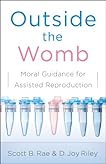
My husband and I are currently going through IVF, so a title like "Outside the Womb: Moral Guidance for Assisted Reproduction" definitely caught my attention. As it turns out, I couldn't be a worse audience for this book. First of all, the title of this book *really* should be "Outside the Womb: Protestant Christian Guidance for Assisted Reproduction" because the only ethical source used here is the Protestant Christian Bible. I have no problem with literature designed to cater to a specific demographic, but books should be *labeled* as such and "moral guidance" implies to me a much broader range than just Christian doctrine.
Literally nothing is consulted in this book except carefully excised passages from the Bible, and the authorial interpretation of those passages. There's no mention of the science or technology behind infertility or assisted reproduction; in fact, the book claims that "infertility - as well as all illnesses or difficulties - is a result of the entrance of sin into the world". The author is a Biblical literalists who believes that Adam and Eve existed and that the "first family" should be modeled in all reproductive choices. He insists that "third party participation" in reproduction (i.e., surrogacy, donated eggs, donated sperm, donated embryos) is not God's plan for people's lives. (The concubines that the Biblical patriarchs had are excused here as being "property". I'm not sure what we're supposed to take from this - "Don't use donated eggs, but buying them is peachy"? I really don't know.)
The "ethical situations" this book proposes to address are strawman cases that will not apply to 99.9% of people. In the case of the "moral repercussions" of donated sperm, the book seriously poses the question "Is this adultery?" (And is that really a concern in the modern Christian community? Because when I was a kid, if private parts didn't touch, you were good as far as God was concerned.) There's also the "what if two lesbians have an IVF child and then they break up five years later?" panic button, and it's particularly insulting that there's no corresponding "what if a man and a woman have an IVF child and they break up five years later?" question in ethics. I guess it's only a moral issue if lesbians are involved? (By the way, the author insists that two-person, heterosexual marriage is the only marriage that counts as far as God is concerned, so if you happen to not fit in that bucket, this book *definitely* isn't for you.)
So obviously I was the wrong audience for this book, but if you're a young, heterosexual, Protestant Christian in need of assisted reproduction, then this book should be very interesting, right? Unfortunately, no; the authors just serve up a bunch of lukewarm theology about how frozen embryos should never be left in storage because it's moral to try to carry them all to term, with the implication that if your embryos are disposed of, you're probably a murderer. Since most people can't afford to go back for multiple sessions (it's not uncommon for IVF to cost 10 grand or more), this means that most patients who take this advice will try to convince their physicians to shove all the embryos in on a single try, which is dangerous for both the woman AND the embryos. This "theology" has little relation to what's actually in the Bible and ultimately boils down to "because I said so" on the part of the author. The whole book feels like a cheap cash-in at best and a screed on the "evils" of family planning at worse, especially when it starts asking if older women should be legally barred from using their embryos.
I actually consider this book to be massively harmful for anyone struggling with infertility. Infertility is very emotionally and physically trying, and I think it's reprehensible to make someone feel guilty for considering using donated eggs or donated sperm because God doesn't want "third party" DNA in your family; or for couples to suddenly feel pressured to become the next OctoMom because the authors have decided that donating unused embryos to infertile couples or leaving the unused embryos in frozen storage is somehow immoral because 'the Bible says so', even though it doesn't. Maybe some theologians may find this book interesting and worthy of debate, but if you're looking at this because you're personally going through assisted reproduction, I would recommend giving this book a complete pass.
NOTE: This review is based on a free Advance Review Copy of this book provided through NetGalley.
~ Ana Mardoll
View all my reviews
|
|
Review: The Healer's Apprentice |
 The Healer's Apprentice
by Melanie Dickerson
My rating: 1 of 5 stars
The Healer's Apprentice / 978-0-310-72143-7
I really wanted to like this book, but there's just so many things wrong with it that I can't - I found this book to be completely lacking in every literary category I can imagine.
My first complaint with this book is that the entire novel is quite literally centered around the trope Poor Communication Kills**.
** (From TV Tropes wiki: "Poor Communication Kills is when a misunderstanding is entirely implausible and against the characters' previously exhibited communication skills, personality, and relationships, and any normal person could clear up the misunderstanding in less than 30 seconds and solve the plot.")
PCK plots are frustrating enough in retrospect, but the PCK plot here is so blatantly obvious that I guarantee the reader will have the entire plot worked out in advance LONG before the halfway mark, leaving an unsatisfying slog to the end as the characters laboriously work out what the reader has already figured out ages ago. The book is styled as a "Sleeping Beauty" reboot (which is why I picked it up), but the connection is extremely tentative and superficial at best, and this is the first fairy tale retelling I've ever read that I didn't like.
I really cannot emphasize enough that the entire plot of this novel, from the first page to the last, revolves around the resolution of the "mystery" of Lord Hamlin's fiancé - and savvy readers will almost instantly be able to hazard an accurate guess on that score. This wouldn't necessarily be a problem if the unraveling of the "mystery" were a story well told, but the action slogs along as the characters "wonder" incessantly about the identity (which the reader has already guessed) and as they compare birthdays back and forth. To make things worse, the characters who obviously are "in the know" are maddeningly silent in the face of serious, major, unarguable reasons to share their knowledge with the principal players. The flimsy justification for this unpardonable and annoying silence - even in the face of obstacles that threaten to result in the *death* of the people these folks are supposedly "protecting" with their silence - is that they *swore an oath of silence*. Talk about "letter of the law" over the spirit, and it's a flimsy way to try to build suspense and drag out the action, kicking and screaming, to the last page.
I hadn't initially realized this was being marketed as a Christian book, so I want to note that in the entire second half of the book, the Protestant proselytization starts getting laid on thick, to the point of completely hijacking the plot. After the halfway point, the action halts almost completely and begins to revolve around prayers and conversations that sound like Protestant tracts on personal (as opposed to intercessor) relationships with Jesus Christ and the utter, absolute importance of virginity, with a side order of how Catholics are "un-Biblical" for believing in the chastity of the clergy, and how the Church doesn't want the laity being able to read the Bible for themselves.
For instance, the setting is Catholic Germany in the 1300's, but the only Catholic "flavor" here is a few quick mentions of priests and some random diatribes against vague "pagans". The *Catholic* main characters have anachronistically personal relationships with Jesus Christ (Mary, incidentally, is not mentioned in this novel even once that I could see), and perform their own personal confessions without the intercession of a priest (because they aren't necessary to the process). Also around the midpoint of the novel, the two main characters start having internal monologues with Jesus Christ almost *every single page*, which really slows down the narrative and makes the book feel more like a "how to pray" instruction book for teens. Literally 40-60 pages are taken up with largely angst ridden prayers and nothing else, and after 10 pages or so it gets really boring really fast. Near the end of the book, there's a completely out-of-left-field scene involving demons (in a book that previously had no mention of the supernatural!), and the main characters end up literally casting out demons in the name of Jesus Christ BY THEMSELVES without seeking the help of the qualified priest that lives and works a couple doors down. In terms of "accurately portraying people of a different time period and/or religion", this book couldn't have missed the mark worse than if the title character had become the first female pope.
As a reader, I really don't mind taking a few liberties with religions and/or historical accuracy - skew everything until it resembles a Slinky, as long as you do it in service to an interesting STORY. Unfortunately, somewhere along the way, the entire story got jettisoned into boring, preachy sermons about (a) the crucial importance of not kissing your betrothed too much the night before your wedding, (b) of always keeping 19-year-old oaths of silence even when there's a good chance that doing so will completely and totally ruin the lives of everyone you know, and (c) in the face of apparent demon possession, the "responsible" thing to do is to immediately start casting those demons out on your own, despite the fact that people can and have *died* in real life because of that kind of behavior. (Google "what's the harm exorcisms" for a long list.)
I wouldn't recommend this book to anyone, ever. In my personal opinion, this was the worst novel I've read this year, and I'm writing this in November.
NOTE: This review is based on a free Advance Review Copy of this book provided through Amazon Vine.
~ Ana Mardoll
View all my reviews
|
|
Review: How to Survive a Garden Gnome Attack |
 How to Survive a Garden Gnome Attack
by Chuck Sambuchino
My rating: 1 of 5 stars
How to Survive a Garden Gnome Attack / 978-1-580-08463-5
I'm a big fan of the "Zombie Survival Guide" - I must have read my copy at least three times. It's incredibly funny and incredibly immersive, largely because it takes itself so seriously. Literally, the Zombie Survival Guide handbook is *THE* last word in zombie survival guides. Sure, zombies don't actually exist, but if some misguided soul whipped up a zombie virus in a lab tomorrow, everything in that survival guide would instantly be true, and inordinately useful. And it's that lavish attention to detail, and utter devotion to the no-nonsense spirit of survival handbooks that makes the Zombie Survival Guide so thoroughly awesome.
However, in the rush to cash in on the trend, "How to Survive a Garden Gnome Attack" tripped and fell headlong into the mud. The serious tone that is so crucial for this sort of guide is only halfheartedly attempted, and in most cases it's thrown to the wind entirely: the section on animal protectors, for instance, is titled "A Big %&*! Dog". (Apart from the juvenile "ha-ha, profanity!", it doesn't even work as a title. As an addendum modifier to 'big', the only words that really fit are a three letter word, or a four letter word with 'ing' appended. A four letter word without 'ing' doesn't fit there; it breaks flow. The author can't even get profanity right. *sigh*) The book also breaks the cardinal sin of trying to be funny with footnotes - I have never, ever seen this work, outside of maybe a Dave Barry book. Putting an asterisk in the text and then tossing in "* You may be totally screwed," as the 'note' at the bottom of the page isn't funny - it's lazy. Why not just write "Insert joke here"?
When the book isn't desperately trying-and-failing to be funny, it spends the rest of the time trying-and-failing to mimic the survival guide tone - it feels like the author has never read a survival guide before. Gone is the carefully measured tone and the lavishly outlined instructions - all the pointers and tips are flung out willy-nilly in a quick, casual, conversational tone. It's because of this strip-mining approach to survival guide writing that "How to Survive a Garden Gnome Attack" is literally 106 pages long, with a full-page picture of a garden gnome every third page. Why didn't they just make this a pamphlet? Then you could at least distribute them for giggles at the grocery store.
I didn't find this book funny, and I doubt it will amuse the guests as a coffee table book. Really, all it made me do was want to dig through the Zombie Survival Handbook again for the fourth time.
NOTE: This review is based on a free Advance Review Copy of this book provided through Amazon Vine
~ Ana Mardoll
View all my reviews
|
|
Review: A Wife's Revenge |
 A Wife's Revenge
by Eric Francis
My rating: 1 of 5 stars
A Wife's Revenge / 0-312-98519-3
In order for a true crime story to really resonate with the reader, there needs to be either a sense of the unique or a sense of outrage as justice is sought (and possibly denied). This book does neither, and manages to load up on shoddy second-hand journalism and editorializing to boot.
First of all, there is nothing shocking, sensational, or new about this case. A husband - one with a serious coke habit (so much so that he ran deeply into debt and came home high frequently), who abused his wife and children, and who brought home STDs to his unsuspecting wife after business trips - is murdered in bed. The wife is either a woman fed up and turned killer, or a seriously mentally shaken abuse victim.
Neither of those options are particularly new or noteworthy, and what little interest the reader may initially have will surely flag as Jeffrey Wright is carefully laid out as an incredibly unsympathetic victim - a man who comes home high on coke and forces his 4-year-old son to "box" with his father. And if Susan is truly mentally damaged - and despite the author's best efforts, she really seems to be so - then the reading isn't driven by a sense of righteous anger, waiting for justice to be done, but rather by a complete weariness that these two messed up people slipped through the cracks and destroyed one another.
The writing here is completely ridiculous. The author openly makes up "facts" because "no one except Susan really knows" and sensationalizes both the killing and the perpetrator. MUCH is made of the fact that for eight days in her 26-year life, Susan was a topless dancer. Eight days out of ~10,000 is not enough to leave a lasting impression - I certainly doubt it did for Susan - but the author refers to her as a stripper practically every third page. Nice yellow journalism there. When she's not being referred to as a stripper, the author invariably labels Susan as "pretty little wife" and "hot little wife". Someone, somewhere, has written a nice feminist treatise on the word "little" and how it means so much more than just "small" when applied to women, but I suppose now isn't the time or the place.
The section on domestic abuse is just sickening. Author Francis deadpans: "Most abused women don't have any great-sounding reason why they let somebody pound on them again and again... If every woman who got hit in this country simply stood up on the spot, gathered up any kids, and permanently left the person who'd hit them, there wouldn't really be much concern with a 'cycle of violence and abuse'." I can't begin to get out what's wrong with that attitude - way to completely ignore the fact that in many cases women who leave are MORE likely to be killed by their abusers! Way to also ignore the fact that many women in our country aren't equipped to be single parents - does the author know that in several states, being a victim of abuse can mean complete denial of health insurance as a "pre-existing condition"? No, let's just blame the victims who "let" people pound on them.
In closing, it's hard for me to think much of a "true crime" author who writes, "Consider for a moment if the tables had been turned... and it had been Jeff who stabbed Susan... he would have had the proverbial snowball's chance in Hell of succeeding [at trial]." Really? You might want to google "O.J. Simpson".
~ Ana Mardoll
View all my reviews
|
|
Review: The Fertility Journal |
 The Fertility Journal
by Editors of Conceive Magazine
My rating: 1 of 5 stars
The Fertility Journal / 978-0-8118-6245-5
It's funny how book titles influence what a reader expects from a book. If this had been titled "The Fertility Journal: A Day-by-Day Notebook to Write in While Waiting To Get Pregnant", then I probably wouldn't have bought it, but if I *had* bought it, I wouldn't be rating it so harshly. But the title here is "The Fertility Journal: A Day-by-Day Guide to GETTING Pregnant", and that information just isn't here.
Or perhaps that isn't fair. There's a very tiny amount of information on getting pregnant here, but what very little there is here could be found by navigating to Google, typing in "basal", and hitting the random search results button. If you have put even the least amount of thought into getting pregnant, then you already have all the information that this notebook contains.
So what is this notebook good for? Well, it can function as a day planner - if you don't have one already - while you're waiting to conceive. And there's quite a few "when you DO get pregnant, you need to be aware of..." information sidebars scattered through the pages - not enough to write home about, and certainly nothing containing information you probably haven't already read elsewhere, but enough to make me wonder why they didn't title the book "looking ahead to pregnancy" instead of "guide to getting pregnant", but I should stop beating that dead horse, I suppose.
Most of the medical advice is questionable, at best. I had to hoot at the section that advised you to ignore "your friend's doctor" and only listen to your doctor in case of conflicting advice, because *your* doctor knows what s/he's doing. Apparently "get a second opinion" is considered controversial advice nowadays.
Really, if you're trying to get pregnant, this notebook may do you more harm than good - the sheer dearth of information on how to get pregnant "faster" may be discouraging to women who were hoping for a little more helpful information on how to game the odds other than the old "every other day, and check your basal temperature" information that every website contains. If you just really need a pregnancy-themed day-planner, then go ahead and buy this, but at $15 bucks a pop, you'd be better off with a plain notebook, in my opinion, and you wouldn't have to deal with three whole chapters on dieting with such helpful tips as "write down every diet you've ever followed and if it worked". (Because starting a new diet is SO low-stress and so good for your self-esteem and sex drive when you're trying to conceive.)
~ Ana Mardoll
View all my reviews
|
|
Review: Mansfield Park and Mummies |
 Mansfield Park and Mummies
by Vera Nazarian
My rating: 1 of 5 stars
Mansfield Park and Mummies / 978-1-60-762047-1
I loved "Sense and Sensibility and Sea Monsters" and "Pride and Prejudice and Zombies", and I really wanted to love "Mansfield Park and Mummies", but I felt that this book was such a rushed and sloppy attempt to cash-in on the current "Austen and monsters" trend that I really cannot recommend it to anyone.
"Pride and Prejudice and Zombies" and "Sense and Sensibility and Sea Monsters" were both wonderfully good laughs largely because they perfectly imitated the ebb and flow of Austen's writing style, and because they took the basic format of the source novels, and then reworked the text into a whole new narrative - completely new material, but with a completely authentic Austen feel. "Mansfield Park and Mummies", however, completely fails to imitate Austen's style - the parts where Author Nazarian's writing takes over occur with an almost audible 'clunk'. Furthermore, the source text doesn't feel rewritten into a whole new story - it feels like "Mansfield Park" but with random references to mummies and werewolves shoe-horned forcibly in. When you strip that subtlety away, you've lost a large part of the "Austen and monsters" humor.
Frustratingly, the lack of subtlety doesn't end there. The "scholarly notes" that sprinkle the book from page to page strain so hard at being funny, they might as well have been written in flashing neon pink. The "note" for "her bitter answer to her sisters put an end to all intercourse (1) between them" is a bald-faced "Ahem!". Ha, ha, it's a *sex* joke! Get it? 'Cause 'intercourse' means a little something different now than it did then? Moving on: the footnote for "adze" is, "An ancient metal thing. Seriously, thou needst google it." I don't even know what to say about this - why is a note in an Austen novel written in Ye Olde Butcherede Englishe? It feels like some poor, beleaguered editor rushed through this novel in one evening, adding 'funny' footnotes in order to get the book out to press the next morning.
Beyond all the juvenile let's-snicker-because-Ms.-Austen-said-'intercourse' folderol, this novel fails because too much was attempted here. The backdrop is "mummies", but that doesn't stop Nazarian from insistently shoe-horning in werewolves, because the two themes work so well together, after all. Perhaps the editors thought that the previous two books had zombies AND sea monsters in the same novel and wanted to present an equally bizarre juxtaposition, who knows.
Overall, this feels like a rushed product, hurried out to milk as much as possible out of the PPZ/SSSM fad, in the hopes that good writing, careful world building, and actual humor were optional. I'm only sorry I paid full price for it.
~ Ana Mardoll
View all my reviews
|
|
Review: Marie Antoinette |
 Marie Antoinette
by Antonia Fraser
My rating: 1 of 5 stars
Marie Antoinette / 0-385-48949-8
I love reading and learning about Marie Antoinette as a historical figure - she had such a fascinating life, and was such an interesting person - but I could not have been more disappointed with this book. I'm really surprised that it has so many high ratings, so take my review with a grain of salt, but I just found this book to be a complete chore to wade through.
It's really frustrating to see Fraser take such a fascinating historical figure and rob her of all interest with some of the dullest writing and bald assertions I've ever seen in a biography. I'm sorry to say that the book reads like the worst of high school history books - dryly vomiting up names and dates with very little context, and jumping about the map to cover events "chronologically" with very little effort made to tie events to one another with any sort of compelling or competent narrative. Fraser seems to regard name-dropping and quote-dropping as being most crucial details, and thus she never hesitates to drop in random quotes from various philosophers, sooth-sayers, and poets - even when doing so is distracting and detracts from the narrative flow.
Too much bald assertion is used here, and to ill effect. For example, Fraser insists that Marie Antoinette's memorable "re-dressing" ceremony was simply not bothersome or traumatic to the young woman, because it was the fashion of the time, not unusual at all, and that "she had, after all, been treated as a doll, to be dressed up in this and that at the adults' whim since childhood; this was just one more example of that process." This may be personal preference, but I dislike this style of writing in biographies - either tell us how the subject felt through actual, historical sources OR tell us how they *might* have regarded an experience, based on conjectures from personality documented through actual, historical sources. Do not, however, just attempt to "channel" the spirit of the biography from the depths of time, and tell us how they felt, because it's just not accurate - it's one woman's opinion. The entire book is written in this vein, and you just never get the impression that you're reading actual history, but rather Fraser's version of how she has decided it must have been. Whether you trust her to be the expert and know what she is talking about is another matter.
I recommend avoiding this book. As a source for Marie Antoinette, I found it sadly lacking, as much of what Fraser asserts as truth is undocumented at best. As reading material, I was repulsed by the turgid prose and by the jump-around-the-map, cram-everything-in-without-context, and drop-a-lot-of-cool-sounding-quotes approach to history.
~ Ana Mardoll
View all my reviews
|
|
Review: Left Behind or Left Befuddled |
 Left Behind or Left Befuddled
by Gordon L. Isaac
My rating: 1 of 5 stars
Left Behind or Left Befuddled / 978-0-8146-2420-3
I have read and enjoyed several scholarly books on the "Left Behind" phenomena, and am an avid reader of Fred Clark's Slactivist page-by-page treatment of the series, but I feel strongly that this book is a very poor addition to genre and I do not recommend it.
I am not usually pleased when a scholarly work defines itself largely in rhetorical questions, and much of this book devotes itself to that format. Isaac asks "What are we to make of this? Well, author so-and-so says..." and "What are we to think about this other? Well, church authority whats-his-name believes...". In his first chapter alone, Gershom Gorenberg is quoted on almost every page, and we hear more of his opinion than we do of Isaac's! What is somewhat worse, based on the blandness of Isaac's opinions and assertions, I find myself wishing I was reading *more* of Gorenberg, and not less. This lackluster approach to scholarship ('I have nothing much to say, so I'll quote people who do') is something I expect more from a first-year student being forced to write a book report over something that failed to resonate with them.
When Isaac does start throwing down facts and opinions of his own, his 'facts' are shockingly incorrect. In the very second chapter, he boldly claims that "early Christians" took the writings that we now refer to as The Revelation of John as "a predictive description of the drama to take place at the end of time. For them, the millennium [of a messianic kingdom] was regarded as quite literal". The only way to explain this 'scholarship' is to assume that Isaac slapped this book together from a Tyndale House press release and called it a day. The very idea that "early" Christians (How early? What kind of scholarship is this that we aren't even talking about dates and time periods?) interpreted Revelations in the same sense that LaHaye and Jenkins now do is extraordinarily wrong.
To just assert that "early Christians" believed *anything* at all without any kind of sourcing or material isn't scholarship, it's dogma. Isaac not only disagrees with volumes of scholarly study that indicate that the apocalyptic literature in question could have (and likely was) written as a source of encouragement to the early Christians as a metaphorical representation of their own, current struggles in an effort to avoid trouble if the writings were seized ('We didn't say that *your* kingdom would fall, sir, we were talking about a kingdom in the future. Yeah, the future, exactly.')... well, that kind of omission isn't just bad scholarship - I'm tempted to call it lying.
I note, belatedly, that Isaac's credentials on the subject sum up to being an Associate Professor at a Seminary. I don't like to cast aspersions based on credentials, but I can't help but feel that this shoddy, lack-luster approach is not something I would expect from an affiliate of an accredited university - someone who would be expected to actually back up their writing with clear opinions and well-researched facts, rather than wild mass quoting and bald assertions of facts not in evidence. The only thing positive I can think to say of this book is that at ~150 pages, it is at least short. Though, on reflection, book reports usually are.
~ Ana Mardoll
View all my reviews
|
|
Review: Creative Beginnings in Machine Embroidery |
 Creative Beginnings in Machine Embroidery
by Patty Albin
My rating: 1 of 5 stars
Creative Beginnings in Machine Embroidery / 1-57120-327-3
I've had my new Brother PE700II Embroidery Machine for less than two months now, so I've still got a lot to learn about embroidery. I purchased this book, along with several others, in the hopes of learning how to get the most out of my new machine. I can state, unequivocally, that of the eight books I ordered, this is the shortest, most shallow one of the batch.
The length of this book is almost insulting. It's one thing to know from the Amazon product page that it's only 63 pages - it's another thing to receive the book in the mail on the same day as your Good Housekeeping magazine and PC Gamer magazine and realize that this book is thinner than both of those magazines. It's an even bigger slap in the face when you open the book and see the large fonts, the liberally unused white space, and the plethora of "isn't this a pretty quilt" pictures that comprise nearly the entire book.
Content-wise, there is *nothing* here that isn't covered better and in more depth elsewhere. The whole book, in fact, feels like a cheap and hasty cash-in attempt, which is pretty darn ironic considering that the *FIRST PAGE* starts off with a massively scolding section about how it's totally wrong and inappropriate to borrow an embroidery pattern from a friend because that's an abuse of the copyright. Fair enough, but I wish someone would tell author Patty Albin that throwing together a completely shallow, cookie-cutter "Sewing 101" book and slapping the word "Creative" anywhere in the title name is false-freaking-advertising. There's an *entire page* dedicated in this book to power strips and surge protectors - complete with TWO pictures of surge protectors! There's another *entire page* concerning electric battery backups! The section on irons (yes, there's a *section* on irons) includes a big, full-color picture of an iron... with the super-helpful caption "A good iron is invaluable." Gee, thanks, Patty - I never would have guessed that from my Sewing 101 and Quilting 101 books. Can we talk about embroidery now? Specifically, creative beginnings in such?
Once you plow past the first half of the book, there's a decent (but unforgivably short) section on stabilizers. And, yeah, you definitely need to know about those in embroidery, but "All About Machine Arts" covers stabilizers in WAY more depth and detail... and it's not even an exclusive embroidery book. In fact, I'll just save some time here and point out that *everything* in "Creative Beginnings" is covered in more depth, better detail, and better pictures in "All About Machine Arts" - so if you own that book, you don't need this one. And if you don't own "All About Machine Arts", I recommend it over this book - it's not flawless, but it's extremely helpful, and has more varied and useful projects than this watered-down waste of money that actually thinks advice like "You don't always need a reason or occasion to make a quilt. You can make one just because it's fun," is somehow revolutionary or worth paying for.
If this book had come with the usual array of embroidery designs on CD (usually 50! or 75! designs that actually turn out to be 17 designs, slightly modified each time to triple the final count, but what-can-you-do), I might have been slightly less harsh on it, but the whole book just feels like a complete slap in the face. I can see why the publishers haven't agreed to use the "look inside this book" feature on Amazon - if I'd browsed through this book at all before hand, I wouldn't have bought it. I strongly recommend you pass on this one - I can honestly say I learned *nothing* from this book, and - as I said before - I've been embroidering for all of two months now, so I'm hardly an expert who knows all the tricks.
~ Ana Mardoll
View all my reviews
|
|
Review: Cauldron (Aliens, Book 12) |
 Cauldron (Aliens, Book 12)
by Diane Carey
My rating: 1 of 5 stars
Aliens Novels: Book 12, Cauldron / 978-1-59582-113-3
I usually leave my summary recommendation until the end of my reviews, but this time I'll save time by placing it at the top: This is one of the worst books I've ever read, and it is my exceedingly strong recommendation that you not waste any of your money, or indeed any of your time on this horrendously bad novel.
After the pile of cliche and melodrama that was Carey's previous addition to the aliens series ("DNA War"), I didn't expect high art from "Cauldron", but this book greatly surpassed all my expectations that it would be awful. Although I had expected a heaping pile of cliche, melodrama, and anachronism (Carey habitually fails to comprehend that science fiction writing should have a different tone than a dime store detective novel), covered by a layer of boring "tell-don't-show" exposition and massive editing issues, it seems that I was being uncreative in my predictions and should also have anticipated that Carey would use this latest medium as a breathtakingly narcissistic diversion into her personal hobbies and interests.
"Cauldron" is largely composed of what Carey *wanted* to write about, as opposed to what she was *paid* to write about, which practically speaking boils down thus: this is a book about historic ships, and NOT a book about aliens. That someone signed off on this complete slap in the face of the aliens' readership is another crime entirely, but I have never seen such shoddy writing and complete disregard for the given subject material as Carey shows here. The "About the Author" note states that she's an enthusiast of historic ships, which you'll have already guessed long before you make it to the end note, because hardly a page goes by where she doesn't go off on a completely random tangent in order to spout factoids about ancient ships.
Allow me to elucidate: The main spaceship on which we open - and keep in mind this is supposed to be the distant future, long after humans have colonized other planets and the nuclear war has ravaged earth and most of the history books, for that matter - the main spaceship boasts a gigantic mural on its side of (and I can't believe I'm writing this) the Monitor and the Merrimac locked in battle. You know, the iron-clad ships that fought each other in the American civil war? *That* Monitor and Merrimac? If you don't remember much about the Monitor and Merrimac from school, don't despair - Carey spends several pages devoted to the history of those ships and, indeed, all American civil war era ships in general. Hey, you know those new state-of-the-art Joint Strike Fighter airplanes that American is currently developing? You know how those are being fitted out with murals of Hannibal's mighty Carthaginian war elephants? Of course not! Because that would be indescribably stupid! Oh, yeah, and the space ships of the future have 'stevedores' and 'bosuns' and probably those stupid high-pitched whistles, just because Carey enjoys using those words and describing the historical context behind them... over and over and OVER again...
A lot of "Cauldron" is written like Carey is vaguely aware that science fiction genre exists, and may have even seen a sci-fi movie once or twice in her life (NOT an aliens movie, though, obviously), but the overall concept is still completely foreign. I'm just going to make a blanket statement for all hack sci-fi writers, free of charge: In the distant space-faring future, there should NOT be references to a current "America", "Romania", or "Australia" (*especially* not in the aliens-verse, where Australia-the-continent was completely nuked, and Australia-the-government didn't survive the process). There should NOT be a Dutch-American immigrant on board with English so broken that she says things like "Dat's all dere is toot" (a direct quote, I swear, and roughly translating to "That's all there is to it," in case the context isn't clear). And while I'm the biggest Monty Python fan you can hope to find, you should NOT blatantly shoe-horn in Monty Python jokes into your sci-fi book ("What is the capital of Assyria? The correct answer is 'I don't know that', followed by a scream." I swear this is another direct quote from this novel.), and you *especially* shouldn't shoe-horn in the same joke TWICE, just in case the reader didn't notice your immense cleverness the first time around. And if you have a hobby like, oh, historic ships, or quilting, or chainsaw juggling, it shouldn't take up so much of the book that it completely obscures the main plot and indeed the actual REAL items of interest (i.e. the aliens) aren't even seen until well into the second half of the book.
The "About the Author" note also indicates that when Carey isn't mangling the aliens series, she churns out Star Trek novels by the dozens apparently and while this further confirms my theory that the sci-fi franchises I love must all be in the hands of gibbering lunatics and middle management, I will admit that I can kind-of-sort-of see some of this working for a Star Trek novel. Star Trek is a backwards-gazing science fiction universe, partly because it's a series that deals with the evolution of the human spirit over history, but mostly because TV sets are expensive and every set piece from the 'ancient' 20th century means that the week's episode made it in on-time and under-budget. A movie like "Aliens", however, is a *completely* different world and thematic style, and assuming that a successful Star Trek sci-fi writer will automatically be a good Aliens sci-fi writer is like saying that a Dragonball Z writer could churn out the plot of "Nausicaa" in a given afternoon - being in the same overall genre doesn't mean that the two have ANYTHING in common.
To bring this tirade to an end and sum it all up in a pithy one-line: Authors should not muck up established book franchises in order to indulge their personal and irrelevant hobbies.
~ Ana Mardoll
View all my reviews